
Choosing a wireless communication headset is not about comparing specifications. It is about understanding your team’s communication complexity.
Many buyers focus on range or battery life first. In reality, the structure of communication inside your team matters more. The number of people speaking, the speed of decisions, and the noise level of the environment all determine which system works best.
Before selecting a solution, you need to evaluate how your team actually communicates.
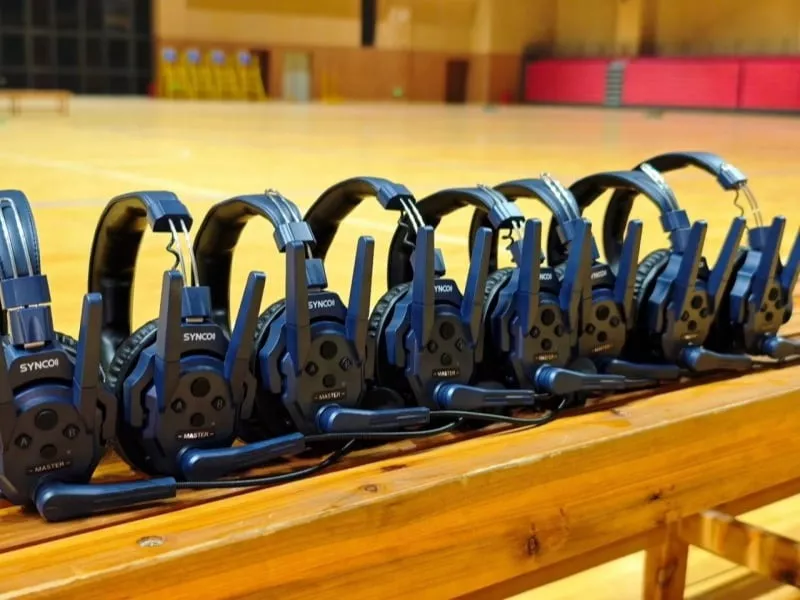
Source: SYNCO
Table of Contents
Communication complexity determines the right system
Not all teams communicate the same way. Some operate with simple command structures. Others rely on constant discussion. The higher the coordination demand, the more advanced the system must be.
A wireless communication headset must match the communication behavior of the team, not just the physical workspace.
There are generally three levels of communication environments.
Level 1: Command based environments
In command based environments, communication is structured and controlled. One person gives instructions. Others respond briefly.
Examples include:
- Warehouse coordination
- Security patrol
- Basic construction supervision
In this structure, overlapping speech is rare. Instructions are short and clear.
For this level, traditional wireless two-way communication headsets are often sufficient. Push to talk operation helps keep communication organized.
Complex full-duplex systems may not be necessary here. Stability and durability matter more than conversational flow.
Level 2: Coordinated task environments
In coordinated task environments, team members exchange information frequently. There is back and forth discussion, but communication is still task focused.
Examples include:
- Small event crews
- Video production teams
- Maintenance teams
Here, interruptions and clarifications happen often. Waiting for a channel to free up slows work.
This is where wireless 2-way communication headsets with more advanced duplex support become valuable. Teams begin to benefit from smoother interaction.
The communication system should reduce friction, not create it.
Level 3: High intensity real time coordination
In high intensity environments, communication is continuous. Multiple members speak naturally, and timing is critical.
Examples include:
- Live broadcast production
- Large scale stage events
- Complex industrial operations
In these scenarios, conversation flow cannot be restricted. Waiting to press a button before speaking creates delay and confusion.
This is where wireless two-way communication headsets with full-duplex mode and mesh network become essential:
- Full-duplex allows team members to speak and listen simultaneously, avoiding delays and interruptions.
- Mesh network ensures stable connections by letting each headset act as a node, automatically rerouting signals if someone moves out of range.
Together, they provide natural conversation and reliable communication for fast-paced, high-intensity environments.
How to choose the right wireless communication headset
Instead of comparing random specifications, follow this structured decision process.
Step 1: Define communication style
Ask:
- Do people interrupt each other often?
- Is conversation natural or strictly controlled?
- Are decisions made collaboratively?
If conversation is continuous and collaborative, prioritize systems beyond basic wireless headset radio communication.
If communication is command based, simpler systems may work.
Step 2: Evaluate team size
Small teams of 2 to 3 users can operate with simpler systems. Larger teams require stable multi user architecture.
Check whether the wireless communication headset supports simultaneous communication among all members without delay.
Scalability prevents future replacement costs.
Step 3: Assess environment noise
Noise level determines microphone quality requirements.
High noise environments require advanced noise suppression. Clear audio prevents repeated instructions and improves safety.
Audio clarity matters more than maximum volume.
Step 4: Consider movement range
Measure the physical size of your workspace. Indoor environments with metal structures reduce signal strength.
Instead of focusing on theoretical maximum range, evaluate stable coverage within your real working area.
Step 5: Analyze battery workflow
Consider shift length and charging opportunities.
If your team works long continuous hours, choose systems with extended battery life or replaceable power modules.
Power interruption disrupts coordination.
Step 6: Prioritize comfort and wearability
Extended wear requires ergonomic design.
Lightweight headsets with balanced pressure distribution improve focus. Poor comfort leads to fatigue and reduced communication quality.
Top recommendation: SYNCO Xtalk Master wireless two-way communication headsets
For professional teams that require stable and efficient communication, the SYNCO Xtalk Master wireless two-way communication headsets are a strong recommendation. Designed for demanding work environments, this system goes beyond basic radio communication.
Its key advantage is the Mesh Talk™ MasterFree 3.0 technology. Unlike traditional systems that rely on a fixed master unit or single transmission path, the mesh structure allows multiple headsets to automatically form a flexible and self-organizing network. Each device works as both a communication node and a signal relay, which improves overall stability and coverage.
It also supports full-duplex communication, so team members can speak and listen at the same time without pressing a push-to-talk button. When someone moves out of range and comes back, the system automatically reconnects, helping maintain smooth coordination during live events, film production, or industrial operations.
Conclusion
A wireless communication headset should match how your team thinks and communicates. Technology should support workflow, not change it.
Instead of focusing only on specifications, evaluate communication complexity, team size, noise level, movement range, and shift duration.
For simple command environments, structured two way systems are often enough. For high speed collaborative operations, advanced duplex communication becomes essential.
Choosing correctly means aligning the system architecture with real world behavior. When communication flows naturally, productivity follows.


